
Wednesday, 28 September 2011
Amphibian immunity is associated with resistance to Bd

High Prevalence of Bd in Gabon

Monday, 22 August 2011
Press coverage in the Pyrenees
 Matthew Fisher and Dirk Schmeller, an English and a German researcher, out to save the world for the Midwife toad in the Pyrenees. That is about the summary of our recent appearance on the French regional TV channel France 3. In between our field work, and just before testing the RACE-Duster on a steep forest road, we also had an interview by La Republique. Finally, earlier this year, the Moulis group starred in another short report for France 3, covering the region of Midi-Pyrenees. You can find the reports under the following links
France 3 - Aquitaine Soir3 (at about 3:40)
France 3 - Aquitaine 19:20 (at about 19 min)
La Republique
France 3 - Midi-Pyrenees
Btw. in case you have missed it on the Aquitaine report, Matthew made sure that the camerawoman films my best side. Check the reflection in the window.

Tuesday, 5 July 2011
CJM 'Emerging infectious mycoses'
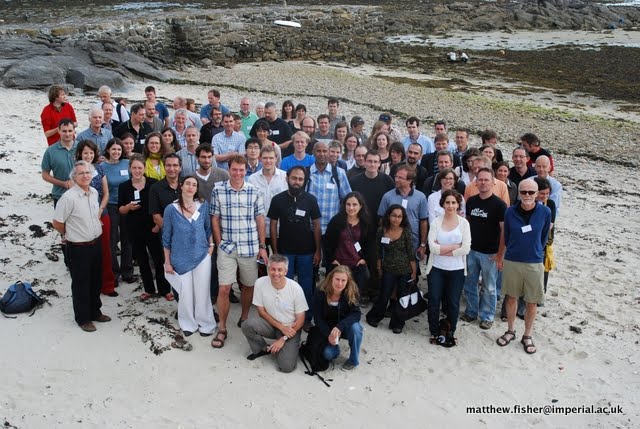 The Conference Jacques Monod meeting on 'Emerging Infectious Fungi' at Roscoff, Bretagne, has just occurred. Organised by Mat Fisher & Tatiana Giraud, the meeting focused on gathering the 'state of the art' together to identify common themes between the 'red' (animal) and 'green' (plant) emerging fungi. Much of what was discussed focused on the role of transcontinental vectoring of pathogens and lack of coherent biosecurity worldwide. Presentations also focused on the mechanisms that generate lineages with enhanced virulence, and ability to switch to new hosts. Ecological mechanisms allowing penetrance of novel fungi into new environments were discussed and genomic tools to track rapidly evolving lineages were detailed. From the meeting, it was clear that we have a proactive and highly knowlegeable community with the ability to speak with one voice. To prevent the further attrition of biodiversity worldwide we need to use this skill to influence those with the power to leverage changes to current practice.
Thursday, 23 June 2011
UV-B lowers the prevalence of Bd infection
 Spanish and UK researchers have shown that common toad tadpoles shielded from environmental UV-B radiation have a higher prevalence of infection compared to animals that were exposed to natural levels of UV-B. This association was also observed for the European midwife Alytes, where the prevalence of infection across the Iberian peninsula was inversly correlated with the intensity of natural UV-B. While it is not known why this inverse association occurs the research, published in Conservation Biology, suggests that increasing UVB may affect host behaviour, making transmission of Bd more unlikely, or may stimulate natural the antimicrobial properties of amphibians to reduce infection rates. The research illustrates the importance of considering multiple stressors when analyzing the complex ecological dynamics of infection by Bd.
Monday, 13 June 2011
Global pandemic affects amphibians – Are you ready to react?
After the publication, we received over 500 responses for the moment, most of them from France, but also from Germany, Spain, Italy, Norway and other European countries. Please, help us spreading the word about this research. The questionnaire exists in three languages
French: http://www.bd-maps.eu/survey/?lang=fr
German: http://www.bd-maps.eu/survey/?lang=de
English: http://www.bd-maps.eu/survey/
Find below the original post.
Please help our research! Currently, we have few means for treating Bd in the wild, and only an active prevention strategy can reduce the further spread of the fungus, and help save our amphibian species. In mountainous regions, walkers, hikers, naturalists, and inhabitants can intervene. Simple gestures may slow down the epidemic, but are you ready to change your habitats? Researchers need to better understand the mechanism of propagation of this pathogen. To assist this research, the RACE project collects data on hiking habits and attitude towards possible conservation measures to stop the spread of this fungus and further amphibian declines. This survey will help this group of researchers to develop mitigation and conservation strategies that are adapted to the public.
Our survey will take you only about 15 minutes and your responses are extremely important and valuable to the researchers!
Please help us and thank you by answering sincerely!
Start the survey here


French: http://www.bd-maps.eu/survey/?lang=fr
German: http://www.bd-maps.eu/survey/?lang=de
English: http://www.bd-maps.eu/survey/
Find below the original post.
Please help our research! Currently, we have few means for treating Bd in the wild, and only an active prevention strategy can reduce the further spread of the fungus, and help save our amphibian species. In mountainous regions, walkers, hikers, naturalists, and inhabitants can intervene. Simple gestures may slow down the epidemic, but are you ready to change your habitats? Researchers need to better understand the mechanism of propagation of this pathogen. To assist this research, the RACE project collects data on hiking habits and attitude towards possible conservation measures to stop the spread of this fungus and further amphibian declines. This survey will help this group of researchers to develop mitigation and conservation strategies that are adapted to the public.
Our survey will take you only about 15 minutes and your responses are extremely important and valuable to the researchers!
Please help us and thank you by answering sincerely!
Start the survey here


Sunday, 8 May 2011
Elevated temperature clears chytrid fungus infections from tadpoles of the midwife toad
 A new study by Corina Geiger et al. (University of Zurich, Switzerland) that was recently published in the journal Amphibia-Reptilia shows that prolonged exposure to elevated temperatures clears chytrid fungus infection in tadpoles of the midwife toad (Alytes obstetricans).
The article is available at
http://www.ingentaconnect.com/content/brill/amre/2011/00000032/00000002/art00015
For PDF reprints, send a mail to benedikt.schmidt ät ieu.uzh.ch
Subscribe to:
Posts (Atom)